


April often brings a mix of uncertainty and transition—and markets are reflecting that. With geopolitical tensions continuing to unfold, we’re hearing a familiar question: “Is this different?” It’s a reasonable question—and one worth answering with both perspective and data.
With that in mind, we wanted to share a brief market perspective, along with a clear framework for navigating decisions during periods like this.

A Market Perspective in a Geopolitical Moment
April has been a reminder of how quickly conditions can evolve. In recent weeks, rising geopolitical tensions drove uncertainty and volatility—followed now by a ceasefire that has helped stabilize sentiment, at least for the moment. Markets responded swiftly, with a notable rally following the announcement—highlighting how quickly expectations can shift as uncertainty begins to ease. It’s important to acknowledge this backdrop for what it is: uncertain, evolving, and understandably unsettling.
While headlines feel immediate, history offers a helpful reminder: markets often react to conflict in the short term—but over time, economic cycles and earnings drive outcomes.
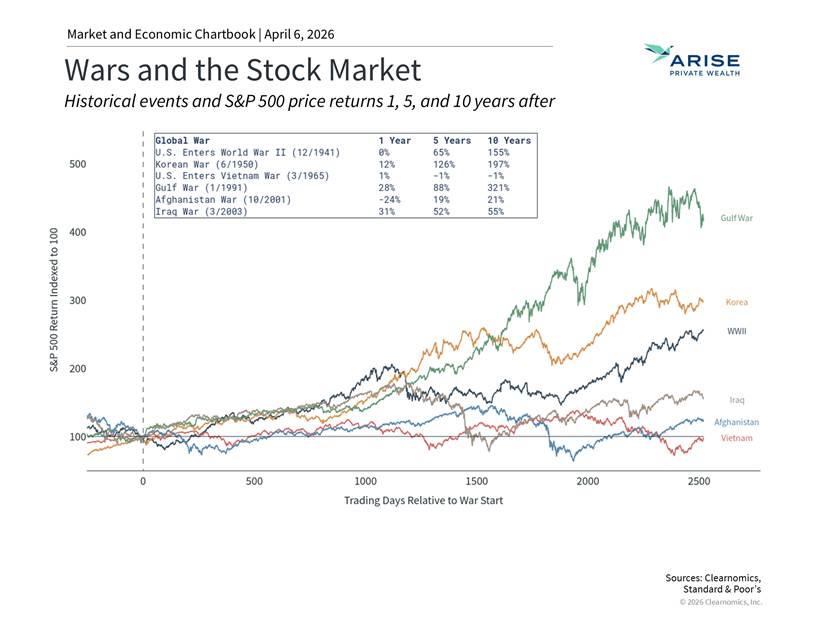
The chart above illustrates this clearly. Across major conflicts—from World War II to Iraq—the pattern is consistent: while markets may experience initial volatility, longer-term returns have been far more dependent on underlying economic strength than the conflict itself.
Two historical periods offer useful context:
- 1990 (Gulf War): A weakening economy and fragile confidence led to initial market declines, followed by recovery before the conflict formally ended.
- 2003 (Iraq War): Stronger economic fundamentals and improving earnings supported markets, which moved higher and entered a multi-year expansion.
Today, we see elements of both—but importantly, there is not yet evidence that the long-term economic or earnings outlook has been meaningfully impaired.
What History—and Current Data—Are Telling Us
Markets have historically demonstrated resilience through periods of geopolitical stress. While short-term drawdowns are common, recoveries have often begun before full resolution is visible in headlines.
Oil, Inflation, and the Strait of Hormuz
A natural question we’re hearing is how disruptions in the Strait of Hormuz could impact oil prices—and, by extension, inflation and interest rates.
Since the conflict began, global oil prices have risen roughly 50–60%, with sharper spikes during periods of escalation. These moves reflect markets pricing in potential supply disruption rather than confirmed long-term shortages.
History provides helpful context. During the 1990 Gulf War, oil prices more than doubled—rising by roughly 110%—before retracing as conditions stabilized. In the lead-up to the 2003 Iraq War, prices increased significantly—on the order of 60%+, depending on the starting point used—before declining as uncertainty eased.
The pattern is consistent: geopolitical shocks can drive sharp but often temporary increases in energy prices. While these moves may influence inflation expectations in the short term, they have not always translated into persistent inflation or a lasting shift in Federal Reserve policy. This dynamic is also driving bond market volatility, as investors weigh the competing effects of inflation pressure and slowing growth on the Federal Reserve’s path.
Looking Ahead
While the path forward is not yet clear, we do not see evidence that the long-term economic or earnings outlook has been meaningfully impaired. Periods like this can feel different in the moment, but the underlying drivers of market returns—earnings, productivity, and economic growth—remain intact. That said, we can acknowledge what many are feeling: this environment is uncomfortable. Energy markets remain sensitive, the Strait of Hormuz is a key variable, and there is no clear timeline for resolution. Yet history shows that markets often begin to recover well before geopolitical tensions are fully resolved—often with surprising strength once clarity starts to emerge. While no one can predict how long this period of volatility will last, the underlying economic foundation and corporate earnings power remain strong. Periods like this can create dislocations—and, in time, opportunities—as conditions stabilize.
A Steady Reminder in Uncertain Moments
Periods like this can feel unsettling—even for experienced investors. When uncertainty rises, it’s natural for attention to shift toward short-term outcomes.
In these moments, we find it helpful to come back to a few grounding questions:
- Have your financial goals changed? If your priorities or circumstances have shifted, that’s meaningful—and worth revisiting together.
- Are your cash reserves where they should be? Adequate liquidity supports flexibility and helps avoid forced decisions at the wrong time.
- Are you holding cash you’ve been hesitant to invest? A structured approach, such as dollar-cost averaging, can help reduce the pressure of timing decisions.
- Do we need to adjust strategy—or stay disciplined? Strategy should evolve when your life changes—not in response to short-term market movement.
Periods of volatility don’t require immediate action—but they do offer an opportunity to reconnect your financial plan to what matters most.
Worth a Read (Key Takeaways)
1) Inflation or Recession? The Tug of War in Bond Markets
- Bond markets are balancing inflation pressures against slowing growth
- This dynamic is driving interest rate volatility
- Markets are processing multiple risks simultaneously—not reacting randomly
2) LPL Weekly Market Commentary
- Markets have historically recovered quickly from geopolitical shocks
- Current volatility remains within normal ranges
- Pullbacks can improve long-term opportunity
3) Nearly Half of College Students Are Rethinking Their Plans Due to AI
- Nearly half of students are reconsidering career paths due to AI disruption
- The future of work is evolving rapidly—even in traditionally stable fields
- Long-term investing reflects how economies adapt over time
4) Nursing as a Path to Stability and Opportunity
- Healthcare demand continues to grow, supporting long-term career stability
- Not all disruption is negative—some sectors are strengthening
- A reminder that opportunity often sits alongside change
An Open Invitation
If any of these questions raised something worth revisiting—or if you’d simply like a second perspective—we’re here. Periods like this are often when thoughtful conversations matter most.
Warmest regards,
Sathya & Steve
Content in this material is for general information only and not intended to provide specific advice or recommendations for any individual. All performance referenced is historical and is no guarantee of future results. All indices are unmanaged and may not be invested into directly. The economic forecasts set forth in this material may not develop as predicted and there can be no guarantee that strategies promoted will be successful.


